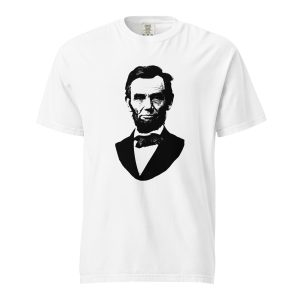
Abraham Lincoln

Bust Image of Abraham Lincoln, 16th president of the United States.

History, Interpretations, and Cultural Perspectives

Historical Life and Legacy

Early Life:
Abraham Lincoln was born in 1809 in Kentucky and raised in a rural environment with limited formal education. He was largely self-taught and developed skills in reading, writing, and law.

Career:
Lincoln worked as a lawyer and served in Illinois state politics before being elected president. He became known for his communication style, debate skills, and political leadership.

Presidency (1861–1865):

  • Took office during a period of national division over slavery

  • Led the United States through the Civil War

  • Issued the Emancipation Proclamation in 1863

  • Supported the passage of the 13th Amendment, which abolished slavery

  • Emphasized preservation of the Union and post-war reconciliation

Assassination:
Lincoln was assassinated in April 1865 by John Wilkes Booth shortly after the end of the Civil War. His death had a significant impact on the nation and contributed to his lasting historical legacy.

Conspiracy Theories and Alternative Interpretations

Broader Conspiracy Claims:
While historical accounts identify Booth as the assassin, some alternative theories suggest the possibility of a wider network of collaborators, including Confederate sympathizers or other groups. These claims vary in scope and are not supported by mainstream historical evidence.

Associations with Secret Societies:
Some narratives connect the assassination to organizations such as fraternal or religious groups. These interpretations are generally considered speculative and are not substantiated by established historical research.

Questions About the Plot:
Discussions about whether the assassination involved additional participants beyond those officially identified have contributed to ongoing public interest. Historians have examined these questions extensively, with most concluding that the known conspiracy was limited in scope.

Religious and Cultural Interpretations

Religious Themes in Speeches:
Lincoln’s writings and speeches, including his Second Inaugural Address, contain references to moral responsibility, national conflict, and the consequences of slavery. These themes have been interpreted in various religious and philosophical contexts.

Martyrdom and Legacy:
Following his assassination, Lincoln has often been portrayed as a unifying or symbolic figure in American history. Some interpretations describe his death in moral or spiritual terms, reflecting broader cultural narratives rather than historical conclusions.

Historical Turning Point:
The end of the Civil War and Lincoln’s death are sometimes viewed as a major transition in U.S. history. Interpretations of this period vary depending on historical, political, or cultural perspectives.

Symbolism in Cultural Narratives

Leadership and Conflict:
Lincoln is frequently associated with themes such as national unity, leadership during crisis, and the challenges of governance during conflict.

Change and Transition:
His presidency and assassination are often seen as representing a period of significant transformation in the United States.

Interpretive Frameworks:
Some narratives—particularly outside mainstream history—place Lincoln within broader symbolic or philosophical frameworks. These interpretations reflect the perspectives of specific groups or traditions rather than established historical consensus.

Summary

Historically:
Abraham Lincoln served as the 16th president of the United States, led the country through the Civil War, and played a key role in the abolition of slavery. He was assassinated in 1865 during a pivotal moment in American history.

In alternative interpretations:
Some theories propose broader conspiracies or additional influences surrounding his assassination, though these are generally not supported by mainstream historical evidence.

In cultural and religious contexts:
Lincoln is often portrayed as a symbolic figure associated with themes of leadership, sacrifice, and national transformation, with interpretations varying across different perspectives.

References and Source Material

The following sources include historical records, academic research, and a range of cultural and interpretive perspectives related to this topic. Their inclusion reflects their presence in public discussion and analysis and does not imply endorsement of any particular viewpoint.

Books

Academic and Historical Sources
  • Manhunt: The 12-Day Chase for Lincoln’s Killer — Account of the pursuit of John Wilkes Booth following the assassination.

  • American Brutus: John Wilkes Booth and the Lincoln Conspiracies — Examination of Booth’s actions and the individuals involved.

  • Blood on the Moon: The Assassination of Abraham Lincoln — Investigative study of the assassination and its context.

  • The Assassin’s Accomplice: Mary Surratt and the Plot to Kill Lincoln — Focus on Mary Surratt and the trial proceedings.

  • The Hour of Peril: The Secret Plot to Murder Lincoln Before the Civil War — Analysis of the Baltimore Plot.

  • Fortune’s Fool: The Life of John Wilkes Booth — Biography of Booth.

  • My Thoughts Be Bloody — Exploration of the Booth family and historical context.

Popular and Interpretive Works
  • Killing Lincoln — Popular retelling combining historical narrative with dramatization.

  • The Lincoln Conspiracy — Focus on the Baltimore Plot with interpretive framing.

  • The Lincoln Conspiracy — Presents broader conspiracy claims.

  • Dark Union — Explores controversial alternative theories.

  • Lincoln Legends — Examination of myths and misconceptions surrounding Lincoln.


Films and Television

Historical and Dramatic Interpretations
  • The Tall Target — Fictionalized account of the Baltimore Plot.

  • The Conspirator — Dramatization of the trial of Mary Surratt.

  • The Day Lincoln Was Shot — Depiction of the assassination and its aftermath.

  • Manhunt — Series focusing on the search for Booth.

  • The Prisoner of Shark Island — Story centered on Dr. Samuel Mudd.

Fictional and Speculative Interpretations
  • National Treasure: Book of Secrets — Adventure narrative incorporating conspiracy themes.

  • Timeless — Includes an episode involving Lincoln’s assassination.

  • The Twilight Zone — Episode exploring alternate outcomes.

  • Abraham Lincoln: Vampire Hunter — Fictional reinterpretation.

  • Abraham Lincoln vs. Zombies — Alternate fictional narrative.


Documentaries and Docudramas

Historical and Educational
  • American Experience — Episode on the assassination and its aftermath.

  • The Hunt for John Wilkes Booth — Focus on the manhunt.

  • Lincoln’s Last Day — Reconstruction of events.

  • Unsolved History — Episode examining earlier threats.

Popular and Alternative Interpretations
  • Killing Lincoln — Docudrama adaptation.

  • Conspiracy? — Episode exploring alternative theories.

  • The Lost Lincoln — Investigates historical claims and artifacts.


Music

  • John Wilkes Booth — Modern folk interpretation.

  • The Ballad of Booth — Theatrical portrayal of Booth’s perspective.

  • Booth Shot Lincoln — Traditional American folk piece.

  • Battle Hymn of the Republic — Period hymn associated with the era.


Photographs and Visual Media

Historical Documentation
  • Alexander Gardner — Portrait of Lincoln (February 1865).

  • Lincoln’s Second Inaugural Address photograph (March 4, 1865).

  • Jeremiah Gurney Jr. — Funeral photograph (1865).

  • Currier & Ives — Assassination lithographs (1865).

Cultural and Interpretive Images

  • Execution of the Lincoln conspirators (July 7, 1865).

  • William H. Mumler — “Ghost of Abraham Lincoln” photograph (1872).

Related Products